Guide · Retail
Shrinkage: what a security guard really changes in a shop
An anti-theft gate only deters people who do not know how to get round it. Shrinkage is tackled by someone who knows the shop, knows where high-risk products move, and shows up at the right moment.
Key points
Shrinkage — the gap between theoretical stock and actual stock — commonly runs at 1 to 2% of turnover, a large share of which comes from shoplifting and internal theft. A security guard acts above all through deterrence: a visible presence at the entrance and beyond the tills during high-risk time slots, patrols on sensitive aisles, backup for staff. They have no power to search and no power to detain outside a case of someone caught in the act; their value is measured by the drop in the shrinkage rate, not by the number of people stopped.
Contents7 sections
Where shrinkage comes from
Industry studies attribute shrinkage, in proportions that vary by store format, to four sources: shoplifting by customers (often the leading cause), internal theft by staff or contractors, administrative errors (deliveries, labelling, stocktaking, unrecorded breakage) and supplier fraud. A security guard mainly acts on the first two; they often bring the third to light, because regular checks on stockrooms and deliveries turn up discrepancies that have nothing to do with theft.
What matters for you is your shrinkage rate by department. If you already have it, it points straight to the right set-up. If not, a few weeks of observation and rolling stock counts give you the same information.
Where and when it happens
- High-value-per-volume departments: spirits, perfume, razors, small electronics, power tools, meat and cheese counters, branded clothing.
- Blind spots: fitting rooms, aisles not visible from the tills, stockrooms accessible from the shop floor, secondary exits.
- Time slots: late afternoons, Saturdays, sale and holiday periods, opening and closing times, busy moments when staff are tied up on the tills.
- Exposed moments: cashing up, stocktaking, deliveries to the stockroom, staff leaving on staggered shifts.
What a security guard actually does in a shop
| Post | What it prevents | When it pays off most |
|---|---|---|
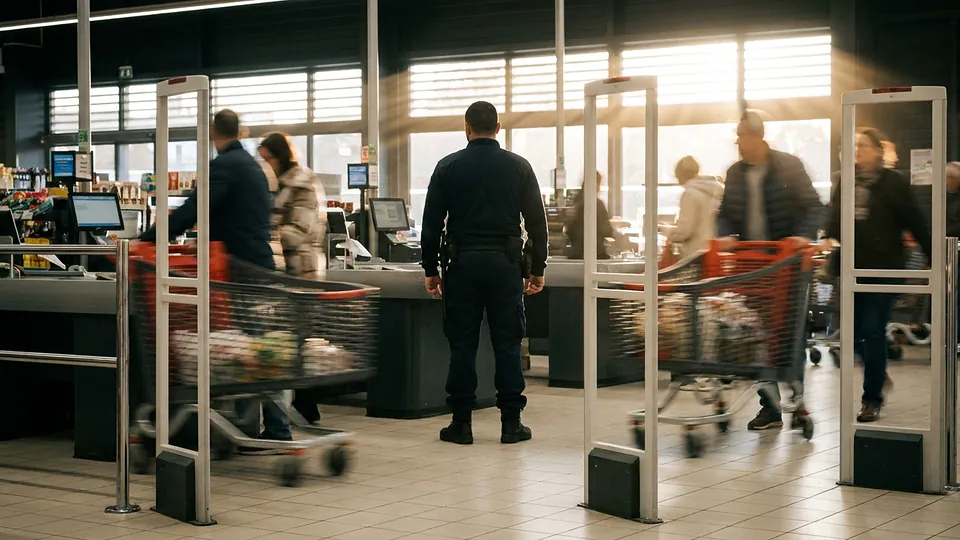
| Beyond the tills (checkout exit) | Skipping the till, concealed items, walking out through the "no purchase" lane | Supermarkets, busy time slots |
| Visible presence at the entrance | Opportunistic theft, which accounts for most cases | Town-centre shops, Saturdays, sales |
| Mobile patrols on the shop floor, in uniform or in plain clothes | Organised theft on sensitive departments, spotting repeat offenders | High-value departments, late afternoons |
| Stockroom and deliveries | Internal theft, receiving discrepancies, stock "forgotten" on the loading dock | Deliveries, stocktaking, cashing up |
| Opening, closing, escorting staff | Assaults at closing time, theft at opening, staff safety as far as the car park | Staggered hours, shopping centres, isolated retail parks |
Across all these posts, backing up staff is a mission in its own right: your sales assistants are not there to confront a thief or an aggressive customer. The guard takes on that role, which protects staff physically and legally — an employee who detains someone outside the legal framework exposes the retailer.
Sizing cover by time slot, not by flat hours
The right question is not "how many hours of guard cover", but "at which times and in which areas". A town-centre shop often gets most of the benefit from a few hours on Saturdays and during the sales. A large food store keeps a fixed post beyond the tills during busy time slots, backed up by patrols on high-value departments. A shopping centre pools a shared scheme between retailers, with a focus on anti-social behaviour and staff safety at closing time. In every case, unpredictable alternation between a visible uniform and plain clothes works best: the uniform deters the opportunist, plain clothes catch the organised offender.
The legal framework, precisely
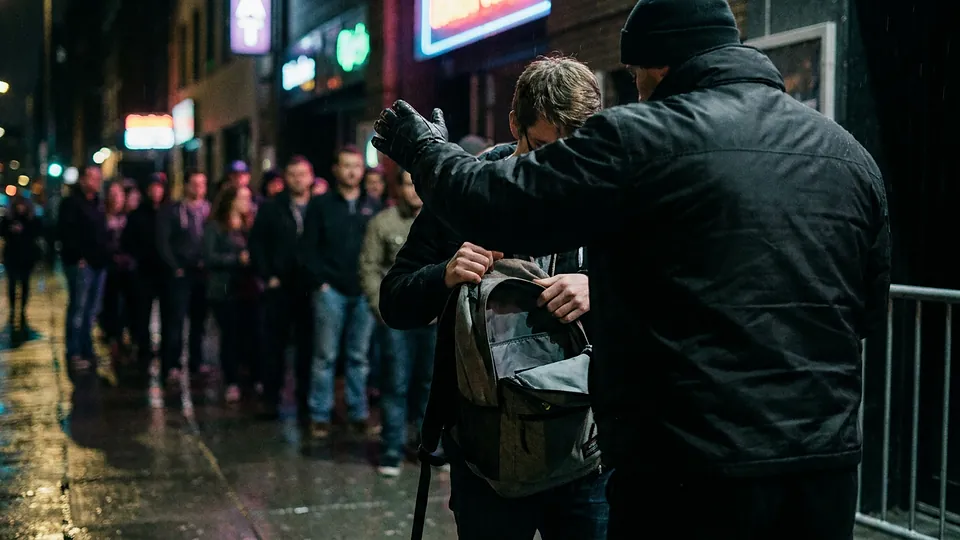
A guard in a shop can offer a visual inspection of a bag, which the customer is free to refuse; they never search a bag without consent. They do not check identity. They may only detain someone within the strict framework of an offence caught in the act (article 73 of the Code of Criminal Procedure — Code de procédure pénale), to hand them over to the police without delay, with no search and no questioning. When in doubt, the rule is to let the person go: CCTV and a description support a complaint afterwards, whereas a wrongful detention costs far more than a stolen item. The detail is in our guide pat-downs, searches and visual inspections.
CCTV complements the guard: on its own it deters little, but it provides the evidence. The guard observes, the camera documents. Every incident is written up in a report that can be used internally, with your insurer and in any legal proceedings that follow.
Measuring the result
A prevention scheme is judged on the shrinkage rate, before and after, department by department, using rolling stock counts — not on the number of people stopped, which only measures the failure of deterrence. The first effects are visible within two to three months. A good secondary indicator is the atmosphere in the shop: fewer incidents of anti-social behaviour, less tension at the tills, staff no longer afraid to close up.
Protecting staff, not just stock
An aggressive customer, a group settling in, a late closing in a deserted retail park: staff safety has become as frequent a request as shrinkage itself. A guard present at sensitive times, clear instructions on who calls whom, and an escort as far as the car park change everyday life for staff — and reduce the absenteeism and turnover these situations cause.
Sources and reference texts
Private security company in Chalon-sur-Saône, published under the responsibility of Richard Le Goff, president. This guide is for information only and does not replace an assessment of your situation: tell us what you need and we'll reply within 24 working hours.
Who we are