Guide · Events
Declaring an event to the town hall or prefecture: thresholds, deadlines, safety file
Declaration, authorisation, safety file: three words that get mixed up, three regimes triggered by different thresholds. Here is which one applies to your event, and what to prepare.
Key points
Three regimes apply. (1) Sporting, recreational or cultural events run for profit with more than 1,500 people must be declared to the mayor — to the Paris police prefect in Paris — between one year and one month before the date. (2) Any march, procession or gathering on the public highway must be declared to the town hall or prefecture at least three clear days beforehand, and any occupation of public land requires authorisation from the mayor. (3) Musical festive gatherings of more than 500 people, outside a fitted-out venue, must be declared to the prefect one month beforehand. Large-scale gatherings are examined through a file reviewed by the prefecture, whose safety section describes the stewarding arrangements, the emergency cover and the evacuation plan. A private reception, wedding or seminar on your own premises does not need to be declared.
Contents7 sections
Which regime applies to your event
| Situation | Procedure | Authority | Deadline | Legal text |
|---|---|---|---|---|
| Sporting, recreational or cultural event run for profit, more than 1,500 people (public and staff) | Declaration | Mayor (in Paris, the police prefect) | At most 1 year, at least 1 month beforehand | Internal Security Code, art. R.211-22 to R.211-26 |
| March, procession, gathering of people on the public highway | Declaration | Town hall, or prefecture depending on the municipality | At least 3 clear days, at most 15 days beforehand | Internal Security Code, art. L.211-1 et seq. |
| Festive event, entertainment, refreshment stall or terrace occupying public land | Occupation authorisation and order | Mayor | Depends on the municipality, often 1 to 2 months | Mayor's policing powers |
| Musical festive gathering of more than 500 people, outside a fitted-out venue | Declaration | Prefect | 1 month beforehand | Internal Security Code, art. L.211-5 et seq. |
| Event in a public-access building (ERP) outside its normal use (a concert in a gym, a trade show in an exhibition hall) | Application for exceptional use | Mayor, after the safety commission's opinion | 1 month beforehand | ERP safety regulations, art. GN 6 |
| Marquees, tents and structures, stands, grandstands | Authorisation, safety register, sometimes the commission's opinion | Mayor | 1 month beforehand | Safety regulations, CTS provisions |
| Fireworks display using higher-category fireworks or above a certain weight | Declaration | Town hall and prefecture | 1 month beforehand | Fireworks regulations |
| Wedding, private reception, seminar on your own premises | None, except for venue constraints (ERP) and neighbourhood rules | — | — | — |
Declaring events with more than 1,500 people
The threshold is assessed on the total number of people likely to be present: the public, but also staff, volunteers, performers and contractors. The declaration sets out the organiser, the nature of the event, the venue, the dates and times, the expected numbers, and above all the planned stewarding arrangements — staff numbers, company, duties — along with the emergency cover and evacuation arrangements. The authority may ask for further information, require the arrangements to be strengthened and, if the measures are insufficient, ban the event.
Two common mistakes: forgetting that a declaration does not amount to authorisation to occupy public land, which remains a separate process; and waiting until you have "all the figures" before submitting the file, when the minimum deadline is already running and the authority would rather receive a file early and have it completed afterwards.
Events on the public highway
A running race, march, procession, gathering: any event on the public highway must be declared in advance, at least three clear days and at most fifteen days before the date, stating the purpose, the venue, the date, the route and the organisers. It must also be accompanied, for anything that occupies public space (barriers, a refreshment stall, a stage, parking), by authorisation from the mayor, who may impose traffic measures, set times and require a security plan. On the public highway itself, keeping public order is a matter for the police and gendarmerie: private security officers secure the site and its access points, and only intervene on the public highway in exceptional circumstances, with authorisation from the prefect (article L.613-1 of the French Internal Security Code).
Musical festive gatherings
A gathering that is exclusively festive and musical in nature, with more than 500 people, held outside a venue fitted out to receive the public, must be declared to the prefect one month beforehand, together with the measures planned for public safety, public health, hygiene and peace and quiet. The prefect may arrange consultation and, if the measures are insufficient, ban the gathering; equipment may be seized if the event goes ahead without a declaration. This does not apply to concerts held indoors or to festivals on a fitted-out site, which fall under the previous regimes.
Large-scale gatherings and the safety file
Beyond the regulatory thresholds, prefectures examine large-scale events at a safety meeting, together with the fire and rescue service, the police and gendarmerie, the SAMU (France's emergency medical service) and the local authority. The organiser presents a safety file which, whatever form it takes, always contains:
- a description of the event: nature, venue, dates, times, capacity per time slot, audience profile;
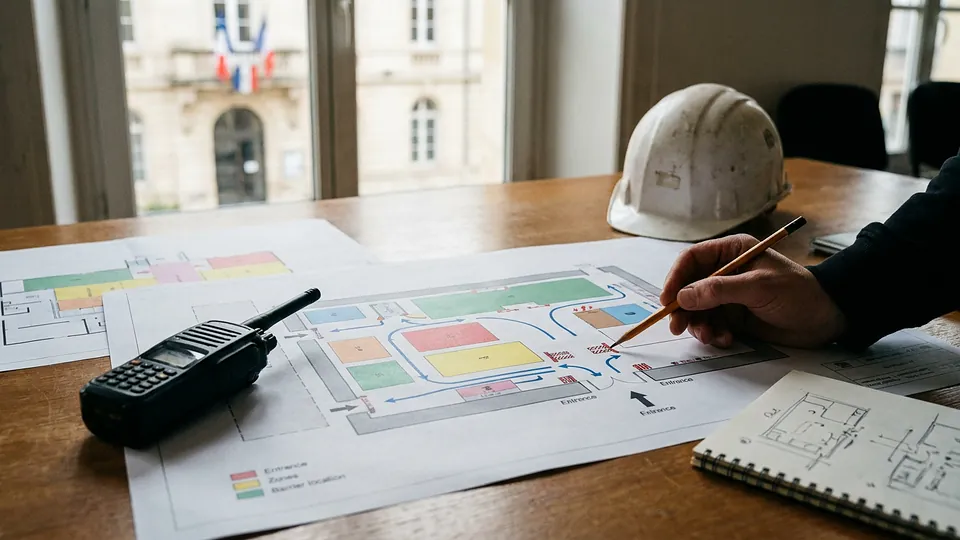
- the site plan: access points, exits, walkways, restricted zones, car parks, first-aid post, command post;
- the stewarding: the company and its operating authorisation number, staff numbers per post and per time slot, team leader, duties, pat-down accreditation where applicable;
- the emergency cover: approved rescue association, sizing, access for emergency vehicles;
- fire safety: resources, structures, SSIAP fire safety officers if the event is held in an ERP;
- evacuation: scenarios, assembly points, means of communication;
- crowd management: ticketing, headcounts, queue management, public information, end of the event.
The security provider usually drafts the stewarding section and takes part in the meeting; the organiser remains responsible for the whole file. To size the stewarding, see how many security guards for an event.
Events in a public-access building
Using an ERP for an activity different from the one it is classified for — a concert in a gym, a trade show in an exhibition hall, a dinner dance in a multi-purpose hall — falls under article GN 6 of the safety regulations: an application to the mayor one month beforehand, the safety commission's opinion, and often a strengthened fire safety service for the occasion. The authorised capacity remains that of the building, not the one the organiser hopes for.
The ideal timeline
- 3 months before: book the venue, make first contact with the town hall, choose the security provider and the rescue association.
- 2 months before: apply for occupation of public land, submit the GN 6 application if the venue is an ERP, prepare the fireworks file.
- 1 month before: declare the event if it has more than 1,500 people or is a musical gathering, submit the safety file, attend the prefecture meeting if requested.
- 15 days before: temporary drinks licence, declaration for the public highway, written instructions agreed with the provider.
- 1 day before: site walk-through, briefing for the guards, checking professional licences, circulating useful phone numbers.
Sources and reference texts
- French Internal Security Code: articles L.211-1 et seq. (events on the public highway), L.211-5 et seq. (musical festive gatherings), R.211-22 et seq. (events with more than 1,500 people), L.613-1 (public highway)
- Service-public.fr — Organising events, marches or gatherings on the public highway
- French Building and Housing Code — safety of public-access buildings
Private security company in Chalon-sur-Saône, published under the responsibility of Richard Le Goff, president. This guide is for information only and does not replace an assessment of your situation: tell us what you need and we'll reply within 24 working hours.
Who we are