
Guide · Regulations
Pat-down, search, visual inspection: what a security guard is allowed to do
Many disputes stem from confusion about what a private security guard can actually do — in both directions. Here is what a guard can do, under what conditions, and what is off-limits.
Key points
A private security guard can visually inspect a bag — you open it, they look without touching — and, with your agreement, search it. A security pat-down, which involves running the hands over your clothing, is only possible with your express consent, carried out by a specially authorised and accredited guard of the same sex as you, and in two cases only: entering an event with more than 300 spectators, or during a period of serious threat confirmed by a prefectural order. A guard has no police powers: they cannot check your identity, cannot hold you except when they have caught you in the act, and cannot search you without consent. They can, however, refuse you entry.
Contents9 sections
Three actions, three sets of rules
| Action | Who can do it | Conditions |
|---|---|---|
| Visual bag inspection | Any surveillance guard holding the CNAPS professional licence | The person opens their own bag; the guard looks without handling the contents |
| Bag search | Any surveillance guard holding the CNAPS professional licence | Consent of the owner; if refused, the only option is refusing entry |
| Security pat-down | Guard specially authorised and accredited by CNAPS (France's private-security regulator), or an accredited member of the organiser's stewarding team | Express consent, guard of the same sex, and either an event with more than 300 spectators or particular circumstances confirmed by a prefectural order |
Visual bag inspection
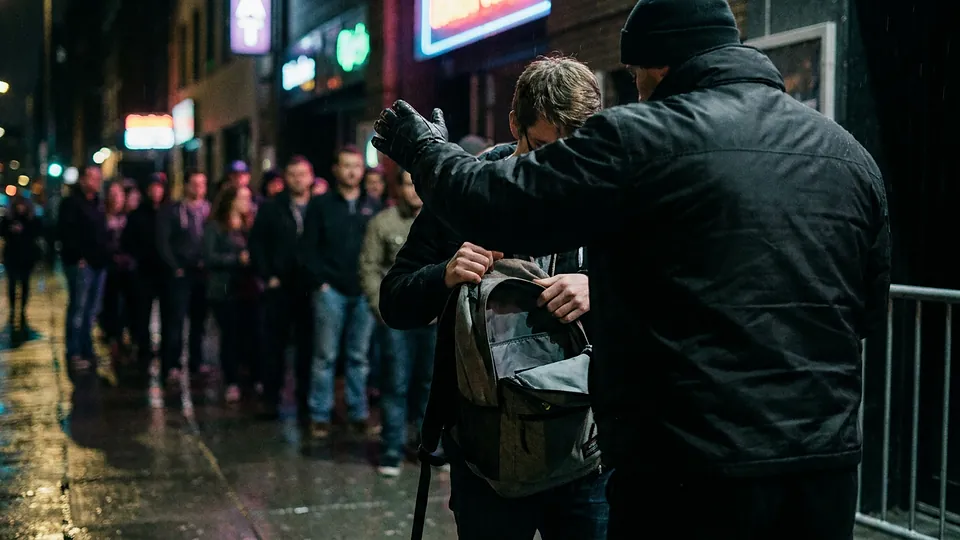
This is the basic check at the entrance to an event, a shop or a site. The guard asks the person to open their bag and looks at the contents, without putting their hands in. It requires no special accreditation, just the professional licence. A person can refuse: the guard cannot then insist or open the bag themselves, but they can refuse entry to the premises, since the organiser or operator has set the conditions of entry.
Bag searches
A search — handling the bag's contents, taking items out — is available to the same guards, but only with the owner's consent. Consent must be freely given: making entry conditional on accepting a search is lawful, forcing the search is not. If refused, the only option is to refuse entry; if there is a clear suspicion, the police can be called.
Security pat-downs
A pat-down involves running the hands over someone's clothing to detect a dangerous object. It is strictly regulated:
- it is reserved for guards specially authorised and accredited by the relevant CNAPS commission — the "pat-down" accreditation is a separate endorsement on the professional licence;
- it requires the person's express consent;
- it is carried out by a person of the same sex;
- it is only possible in two cases: for access to venues hosting a sporting, recreational or cultural event with more than 300 spectators (article L.613-3), or when particular circumstances linked to serious threats to public safety have been confirmed by a prefectural order (article L.613-2).
This is not a body search: the guard does not require any clothing to be removed, does not put their hands under clothing, and does not touch intimate areas. Any pat-down outside this framework is illegal, and an organiser who asks unaccredited guards to carry one out is taking on just as much liability as they are.
Often overlooked: at the entrance to an event with more than 300 spectators, specially accredited members of the organiser's stewarding team can also carry out pat-downs, under the same conditions. This applies to clubs and federations, not to ordinary volunteers of an association.
Refusing entry and removal from the premises
A private venue open to the public can set its own conditions of entry, and the guard applies them: ticket, invitation, dress code, intoxication, behaviour, refusing a bag inspection. They can refuse entry and ask a person to leave the premises on the basis of the venue's own rules. Two limits apply: the refusal cannot be based on discriminatory grounds (origin, sex, disability, religion, orientation, etc.), which is punishable under the Criminal Code, and the guard has no power to physically force out someone who refuses — they must call the police instead.
Detaining someone: only for an offence caught in the act
A guard has no power of arrest. The only legal basis for detaining someone is Article 73 of the Code of Criminal Procedure (Code de procédure pénale), open to any person: where a serious or minor offence caught in the act is punishable by imprisonment, apprehending the offender and taking them to the nearest judicial police officer. Theft is one such offence. But this requires an offence clearly caught in the act — not a suspicion —, force that is strictly proportionate, an immediate call to the police, and no search or questioning in the meantime. A guard who detains someone on a mere suspicion commits unlawful confinement.
That is why the instruction we give our guards in shops is simple: when in doubt, do not apprehend. A legal dispute over a wrongful detention costs infinitely more than a stolen item.
Checking identity
A private guard cannot demand identification: checking identity is the exclusive preserve of the police. They can ask for a ticket, an invitation, a badge, a work order, and can ask to see a document voluntarily to verify someone's age at the entrance to a venue reserved for adults. The person is free to refuse; the guard is then free to refuse entry. They never keep hold of the document.
Weapons and equipment
Surveillance and manned-guarding staff are not armed. There is a separate, tightly regulated regime for armed surveillance, reserved for certain situations and subject to specific authorisations, which does not apply to an ordinary event, shop or industrial site. Standard equipment is limited to uniform, a means of communication and, depending on the assignment, a torch and gloves.
Your options if a guard oversteps
If you believe a guard has overstepped their rights, ask to speak to the team leader or the person in charge of the venue and have the incident logged. You can file a police complaint, and report the matter to CNAPS, which has the power to inspect and impose disciplinary sanctions on companies and guards. For clients, the best prevention remains written instructions that set out these limits, and guards trained to respect them.
Sources and reference texts
- Code de la sécurité intérieure: articles L.613-2 (bag inspection and search, pat-downs) and L.613-3 (events with more than 300 spectators)
- Code de procédure pénale (Code of Criminal Procedure), article 73 (apprehending the perpetrator of a serious or minor offence caught in the act)
- CNAPS — Conseil national des activités privées de sécurité
Private security company in Chalon-sur-Saône, published under the responsibility of Richard Le Goff, president. This guide is for information only and does not replace an assessment of your situation: tell us what you need and we'll reply within 24 working hours.
Who we are