Guide · Private receptions
Security guard for a wedding: do you need one, how many, and at what price?
Couples rarely think about it until a relative tells the story of the wedding where the envelopes went missing. Here’s what a guard actually brings to a reception, how to size the team, and what it costs.
Key points
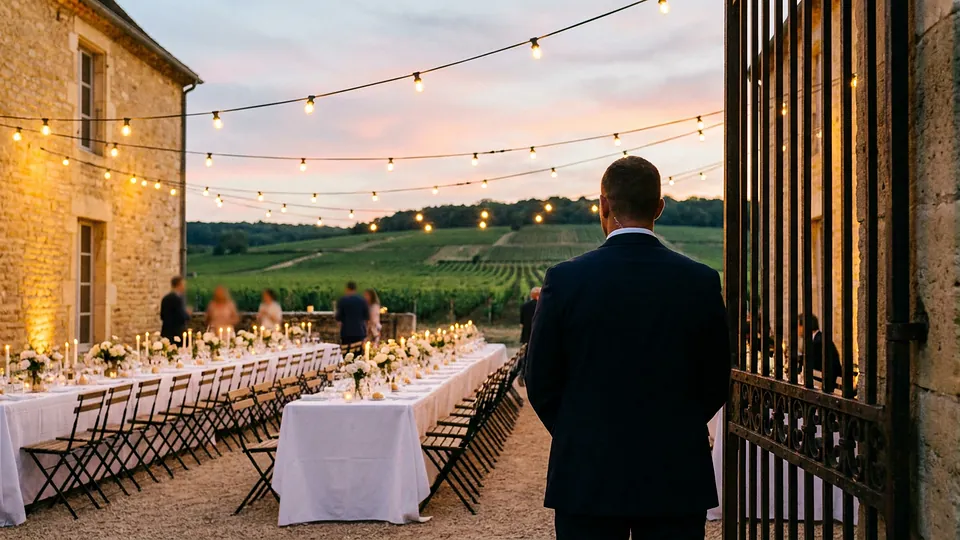
Nothing requires a security guard for a wedding, unless the venue or your insurer demands one. In practice, for 80 to 250 guests at a country venue, two guards in plain clothes are almost always enough: one on the door during arrivals, then both rotating between the reception room, the gift table and the car park until the end of the night. Allow for a shift running from 6 pm to 4 am, around twenty guard-hours, with a premium for night hours and, often, Sunday working. On the market, that works out in 2026 at a budget of around €600 to €900 excl. VAT for two guards, premiums included; the exact quote depends on the venue and the timings.
Contents8 sections
Is it compulsory?
No. A wedding is a private reception: it is subject neither to a declaration to the prefecture, nor to a duty to provide a stewarding service. Two parties can, however, require one: the venue (some estates, châteaux and function rooms require a security presence above a certain number of guests, or for any evening running past 2 am) and the insurer of the venue or the organiser, who sometimes makes cover conditional on a minimum arrangement.
Read the hire contract before signing the quote: it often sets out the time the music must stop, fixed by municipal order, liability in case of damage, and the conditions relating to security. That’s where the answer to “is it compulsory at our venue?” is hiding.
The three classic wedding incidents
A wedding isn’t secured the way a concert is. The challenge isn’t controlling a crowd but staying invisible while everything is going well, and being in exactly the right place the moment something goes wrong. Three situations come up in almost every booking we handle:
- Unwanted guests. An ex-partner, a family member the couple has fallen out with, or simply onlookers drawn in by the music and the open bar at an open-access venue. Screening at the entrance settles the matter without a scene, and without the couple having to step in.
- Theft of envelopes and gifts. The card box and gift table sit unwatched for hours, in a room where dozens of guests and suppliers come and go. This is, by far, the most common theft at a private reception.
- The end of the night. Alcohol, tired guests, old family disputes resurfacing, drivers who shouldn’t be driving, neighbours calling the gendarmerie (France’s rural police force) over the noise. Everything happens between 1 am and 4 am, and that’s exactly when nobody wants to deal with anything anymore.
How many guards?
| Setup | Guests | Recommended numbers | Why |
|---|---|---|---|
| Function room in town, single entrance, lit public car park | up to 120 | 1 guard | Only one point to hold; car park surveillance is minimal |
| Estate, château or rural venue | 80 to 250 | 2 guards | Entrance during the arrivals window, then rotating between room, gifts and car park |
| Large site, several buildings, unlit field used as car park | 150 and above | 2 to 3 guards | Long walkways, isolated vehicles, guests who spread out |
| Reception of more than 250 guests, or a young crowd with an after-party | 250 and above | 3 guards and above | Managing the end of the night and seeing people off the premises |
Two guards are the most common arrangement because they allow rotation: while one stays visible near the entrance or the gifts, the other does a round of the car park. A single guard can’t be in two places at once, and it’s precisely during their round that the gift table is left unwatched.
Suit or identifiable uniform?
Both exist, and the choice is yours. In plain clothes — a dark suit — the guard blends in among the guests and the atmosphere isn’t affected; it’s the most common choice for a wedding. In identifiable uniform, the deterrent effect is stronger at the entrance, which is useful if you’re worried about unwanted arrivals. A mix is possible: visible uniform at the entrance during the welcome, then plain clothes for the rest of the evening.
What the guard does — and doesn’t do
Their duties fit on a set of post orders agreed with you: welcoming and screening guests against a list or invitations, watching the card box and gifts, doing regular rounds of the vehicles, quietly defusing tension by moving the person out of the couple’s sight, keeping an eye on departures at the end of the night, and locking up the site with the venue manager. They never approach the couple during the party unless necessary: you appoint a point of contact — a witness, a parent, a wedding planner — who makes the decisions.
What they don’t do, on the other hand, is anything the law doesn’t allow: check someone’s identity, search a person without consent, or detain someone except when caught in the act of an offence. They can refuse entry, escort a person off the premises and call the gendarmerie. Nor are they a lifeguard or an entertainer: if the venue has a swimming pool, we discuss it at the briefing. The detail of this legal framework is in our guide to a security guard’s rights.
What does it cost?
Billing is by the hour and per guard, with the premiums set by the industry’s collective agreement for night work (9 pm to 6 am), Sundays and bank holidays. The total therefore depends mainly on the shift length: a booking from 6 pm to 4 am comes to ten hours per guard.
| Arrangement | Guard-hours | Indicative budget |
|---|---|---|
| 1 guard, evening from 7 pm to 3 am (Saturday) | 8 hrs | €250 to €350 excl. VAT |
| 2 guards, 6 pm to 4 am (Saturday evening into the small hours of Sunday) | 20 hrs | €600 to €900 excl. VAT |
| 3 guards, 5 pm to 5 am, large site | 36 hrs | €1,100 to €1,600 excl. VAT |
Two factors have affected price since 2026. First, the private security industry’s collective agreement sets a minimum shift of 6 hours: booking a guard for three hours means paying for six. Second, travel is built into the quote and weighs more heavily on a short booking at a remote venue. Everything else — the site visit, the post orders, the guards’ briefing, the incident report — should never be billed on top. Our pricing page details what makes a quote vary, and what should raise a red flag.
Preparing the booking in twenty minutes
You already have a hundred things to manage: our preparation takes one conversation and one set of post orders. Here’s what we need:
- the number of guests, the exact venue and the real timings (arrival of the first guests, the time the music must stop under the municipal order, closing time for the site);
- the access points, the car park layout and its lighting;
- whether there will be children, a swimming pool or a body of water;
- any potentially unwanted individuals, with a description or a photo;
- the name of the point of contact who decides during the evening, and that of the venue manager;
- your choice of dress: plain clothes, identifiable uniform, or a mix.
For a large estate or a site with several buildings, an advance site visit avoids nasty surprises. On the day, the guard takes up position before the first guests arrive, stays in the background during the evening, and you receive a report the following day if there was an incident.
If the venue insists on its own provider
Some venues work with a closed list of providers. Others simply require proof of professional liability insurance and proof of an operating authorisation, which any serious provider supplies without having to be asked twice. Ask the venue exactly what it requires: in the great majority of cases, it’s a matter of paperwork, not exclusivity. And if the venue does insist on its own provider, apply the same checklist to them as to any other: see how to check that a security company is properly licensed.
Sources and reference texts
Private security company in Chalon-sur-Saône, published under the responsibility of Richard Le Goff, president. This guide is for information only and does not replace an assessment of your situation: tell us what you need and we'll reply within 24 working hours.
Who we are