Guide · Events
How many security guards for an event? The method for working it out
The question comes up in almost every quote request, and the honest answer is never a bare number. Here’s the method we apply, the ranges we see in practice, and the mistakes that cost you dear.
Key points
No regulation imposes a ratio along the lines of “one guard per 100 people”. The right headcount is calculated from peak attendance (not total capacity), the number of access points to hold, the site’s layout (enclosed or open), the type of crowd, whether alcohol is involved, and the real finishing time. In practice, arrangements most often fall between 1 guard per 100 people (young crowd, alcohol, open site at night) and 1 guard per 250 (trade show, enclosed hall), with a minimum of two guards as soon as there’s an entrance to hold and an interior to watch, and a team leader from four to five guards upward.
Contents7 sections
There is no legal ratio
Contrary to a widespread belief, no regulation sets a number of security guards per band of spectators for a private, community or commercial event. The French Internal Security Code (Code de la sécurité intérieure) governs who may carry out surveillance — guards holding a professional licence, employed by a company with an operating authorisation — and what they may do, but not how many are needed.
The number of guards comes from three sources: the organiser’s own risk assessment, for which they carry responsibility; any requirements set by the authorities — the mayor or the prefect — when the event is declared or subject to authorisation; and the requirements of the venue or the insurer. The well-known “one guard per hundred people” is no more than a rule of thumb: often about right for an evening involving alcohol, excessive for a trade show, and sometimes not enough for a site that’s open at night.
The six factors that size an arrangement
- Peak attendance, not total capacity. A thousand people arriving over three hours don’t call for the same numbers at the entrance as a thousand people arriving in twenty minutes. It’s the entrances that get overwhelmed, and it’s the peak that sizes the access posts.
- The number of access points to hold. Every entrance or exit held needs at least one guard, often two at peak times: one to check people, one to manage the queue. Four access points mechanically need more than a single entrance.
- Enclosed site or open site. An enclosed hall is controlled from its doors. A park, a square or a field needs a perimeter and mobile teams, because the public can get in anywhere.
- The type of crowd. A trade show, a village dance and a concert with a young crowd don’t call for the same arrangement. The right question is: what happens when something goes wrong, and how many people are needed to deal with it without leaving the entrance short-staffed?
- Alcohol and the closing time of the bar. The vast majority of incidents happen after last orders. An arrangement has to hold until the last vehicle leaves, not just until the end of the show.
- Sensitive points. Backstage, the till, the production office, an unlit car park, a camping area: each can call for a dedicated post, regardless of overall capacity.
Order-of-magnitude figures by event type
The ranges below reflect what we most commonly encounter in Burgundy and the Rhône. They’re meant to help you prepare a quote request, not replace one: two events of the same capacity can need anywhere from one to twice as many guards, depending on the venue and the timings.
| Event type | Capacity | Typical numbers | What makes it vary |
|---|---|---|---|
| Wedding, private reception at a venue | 80 to 250 guests | 1 to 2 guards | Unlit car park, late finish, unwanted guests |
| Birthday party, event with a young crowd | 100 to 300 | 2 to 4 guards | Invitations shared on social media, alcohol, neighbours |
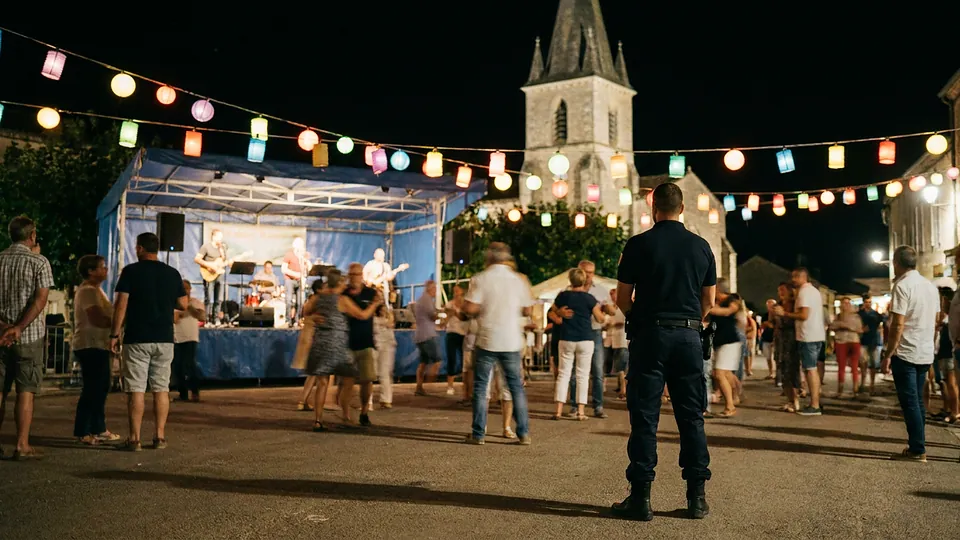
| Dance, village fête, firework display | 300 to 1,000 | 3 to 8 guards | Open site, bar, several access points, surroundings on a public road |
| Indoor concert | 500 to 1,500 | 4 to 10 guards | Peak at doors-open, headcounts, fire exits, the pit |
| Trade show or fair | 1,000 to 5,000 per day | 2 to 6 by day, 1 to 2 overnight | Badge screening, guarding the stands overnight between show days |
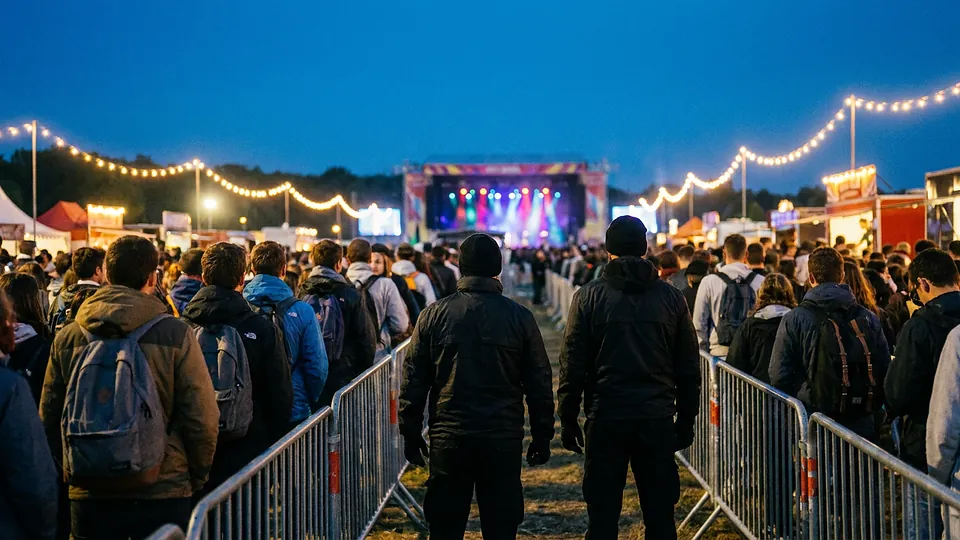
| Outdoor festival | 3,000 per day and above | 10 to 20 per shift | Porous perimeter, camping, several stages, night shifts |
| Amateur sports competition | 500 to 2,000 | 3 to 8 guards | Keeping rival crowds apart, changing rooms, car park, bar |
A team leader is added from four to five guards upward, or as soon as the arrangement covers several distinct posts.
Think in posts, not headcount
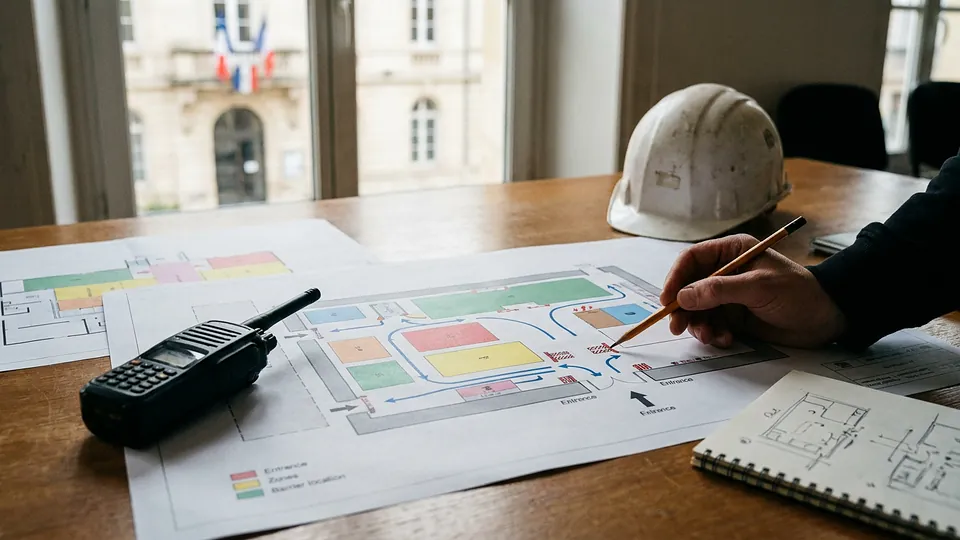
The right method is to list the posts that need holding, then cover them across the whole shift. A complete arrangement generally includes:
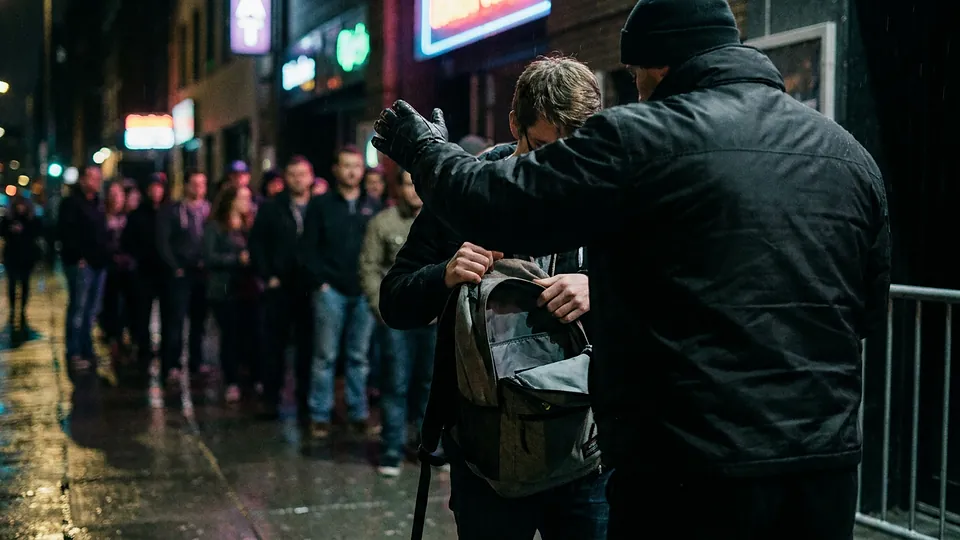
- the access points: ticket or invitation checks, visual bag inspection, headcounts to keep within the authorised capacity;
- a mobile team inside: prevention, managing intoxicated guests, defusing conflict, watching the fire exits;
- restricted areas: backstage, dressing rooms, the production office, the till, drink stores;
- the surroundings and the car park, especially towards the end of the night;
- a team leader, the organiser’s sole point of contact, who keeps the incident log and liaises with the emergency services and the police.
Over a long shift, you also need to plan for changeovers: a guard can’t hold an access point for ten hours without a break. This is why a “six-guard” arrangement can actually involve seven or eight people over the course of the day.
What the mayor or the prefecture can require
Sporting, recreational or cultural events run for profit that are likely to draw more than 1,500 people, audience and staff included, must be declared to the mayor — in Paris, to the police prefect — at least a month before the date (articles R.211-22 et seq. of the Code de la sécurité intérieure). The declaration sets out, among other things, the stewarding arrangements planned, and the authority can ask for these to be strengthened.
Below this threshold, an event on a public road or on public land still needs the mayor’s authorisation, and the mayor’s order can attach requirements: number of guards, timings, the bar’s closing time. Large gatherings are the subject of a security file examined by the prefecture. In every case, if your file states a specific headcount, pass it on to your provider: the quote is built around it.
Don’t confuse private security with first aid: the planned emergency cover (dispositif prévisionnel de secours), provided by first-aiders from an approved civil-safety association, is a separate obligation, sized according to the national guidelines.
The most common mistakes
- Under-staffing the entrance. A queue that spills onto the road puts the organiser at fault before the event has even started.
- Counting the advertised times rather than the real shift length. Guards take up position before the doors open and leave after the last person has gone.
- Standing the arrangement down at the end of the show. Incidents cluster between the bar closing and the car park emptying out.
- Leaving the access points to volunteers. Volunteers can welcome people, give directions and run the ticket desk. Surveillance and screening are a regulated activity reserved for licensed guards, with one exception: members of the organiser’s own stewarding team who are specially accredited for pat-downs, under article L.613-3 of the same Code.
- Choosing on price without reading the detail. A cheaper quote because it plans for three guards where five are needed isn’t actually cheaper: it’s under-staffed, and on the day it’s the organiser who bears the consequences.
A worked example: a village fête with 800 people
The village square, an open site with two main access points, the bar open until 1 am, dancing from 9 pm to 2 am. The arrangement we’d propose:
- 2 guards on the access points during the arrival peak (8 pm to 11 pm), then 1 guard in a central position;
- 2 mobile guards inside and around the bar, until the end;
- 1 guard on the car park and surroundings from 11 pm, until the last person leaves;
- 1 team leader, liaising with the mayor, the gendarmerie (France’s rural police force) and the first-aid post.
That’s 5 people on site at peak time and a shift running from 7 pm to 2.30 am, around 35 guard-hours. It’s this unit — guard-hours, post by post — that lets you compare two quotes honestly. To translate it into euros, see our page on pricing and how we cost a job.
Sources and reference texts
Private security company in Chalon-sur-Saône, published under the responsibility of Richard Le Goff, president. This guide is for information only and does not replace an assessment of your situation: tell us what you need and we'll reply within 24 working hours.
Who we are