Guide · Businesses & sites
Construction site theft: how to protect machinery, copper cable and fuel
A machine out of action means a team standing idle and a schedule slipping. Protecting a site is not just about having a guard: it is about layering measures in a precise order.
Key points
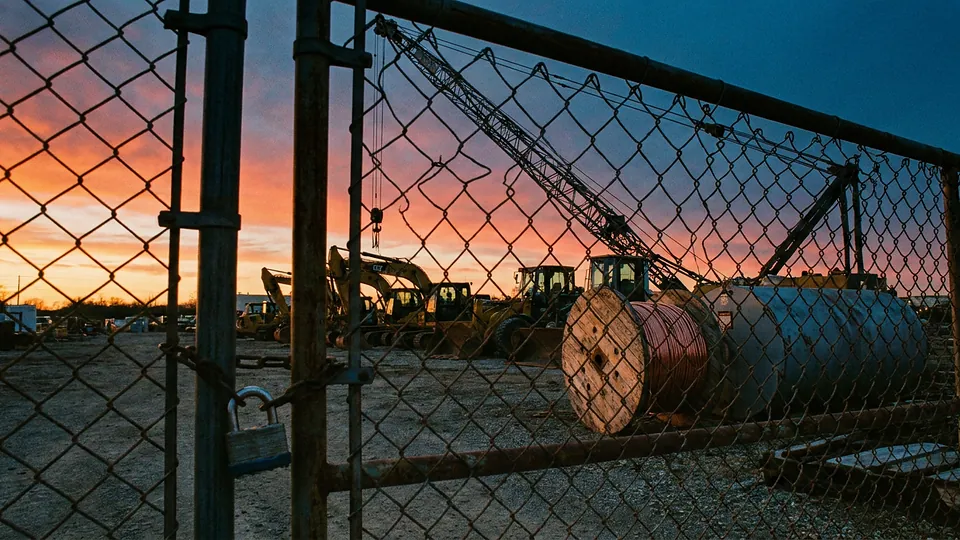
Theft on construction sites mostly happens between Friday evening and Monday morning, over long weekends and the August shutdown. The targets: fuel from machinery, copper cable, power tools and small machinery. Effective protection layers four measures: making access difficult (a closed fence, a single access point, lighting), making theft unprofitable (tanks emptied or protected, copper delivered just in time, machinery marked and tracked by GPS), detecting (temporary remote monitoring, standalone cameras), and bringing in people at the moments of highest risk: random patrols, night-time guarding, a dog handler on large sites.
Contents7 sections
When and what: the risk map
| Target | Risk period | Most effective countermeasure |
|---|---|---|
| Fuel (machine tanks, storage tanks) | Every night, especially weekends | Tanks run low by Friday, anti-siphon caps, tank locked away, patrols |
| Cable and copper | From delivery until installation | Delivered just in time, stored in a locked container, never near the fence line |
| Power tools | Every evening | Locked container or site cabin, inventory, marking |
| Mini-diggers, compactors, generators | Long weekends, bank holidays, August | Grouped together under lighting and camera, immobilised, GPS tracker, guarding |
| Materials (timber, insulation, joinery) | End of the build, second-fix works | Stored inside the closed building, deliveries timed to installation |
| The site itself (squatting, damage) | Sites at a standstill, enclosed buildings | Openings sealed, regular visits, immediate reporting |
The four layers of protection
1. Make access difficult
A continuous fence, closed at night, with a single vehicle access point; lighting for storage areas and machinery parking; machinery grouped together rather than scattered across the site. It is not spectacular, but it is what sends an opportunistic thief to the next site instead.
2. Make theft unprofitable
Tanks run low before the weekend, anti-siphon caps, the fuel tank locked away or emptied; copper delivered just before installation and stored in a container; machinery marked, immobilised (chains, wheel clamps, battery isolators) and tracked by GPS; inventory photographed. A tracked machine gets found; an anonymous one disappears.
3. Detect
Site remote monitoring is rented by the month: standalone masts with cameras and motion detection, sending alerts to a monitoring centre and the site manager. It covers the site continuously at low cost. Its limit: it warns, it does not intervene. See manned guarding or remote monitoring.
4. Bring in people at the right moments
This is the layer that turns an alert into action, and the only one that genuinely deters organised theft. Three options, from the cheapest to the most complete:
- Patrols: two to four visits a night, at random times, checking the fence and machinery, with a time-stamped report. The most common option on a medium-sized site.
- The static post: a guard present all night or all weekend, with written instructions, for the periods of highest exposure or after a first break-in.
- The dog handler team: on large sites and linear projects (roadworks, utilities), the dog detects a presence at a distance and is a strong deterrent. It often replaces a second guard.
Sizing it and costing it
A six-month site with two patrol visits a night, seven nights a week, costs a fraction of what an immobilised mini-digger or a batch of cable on a three-week reorder lead time represents. The right calculation weighs the value exposed in each period against the excess and exclusions in the insurance policy, and the cost of delay. In practice, many companies use weekday patrols and a static post or dog handler for long weekends and the summer shutdown. Price benchmarks are on our pricing page.
Site organisation matters as much as the guard
- Keep an entry log and know which subcontractors are on site: half of "thefts" are untracked borrowing.
- Time deliveries of sensitive materials to installation, not to suit the convenience of the schedule.
- Do a closing round every evening: machinery grouped, tanks, containers, gate, lighting.
- Build surveillance into the prevention plan or the site-specific health and safety plan: the night guard needs to know the site's hazards (excavations, floor openings, buried services).
- Photograph the equipment and stock regularly: evidence for the police report and the insurer.
What insurers expect
Contractor's all-risks insurance and the theft cover in business policies come with conditions: fencing, locking up, lighting, sometimes an alarm or guarding above a certain value of machinery. A claim for a theft that occurred while a condition was not met can be reduced or refused. Read these clauses before the first spade goes in the ground, and report the loss within the period set in the policy after filing a police report, with photos, an inventory and, if there is a guard, their incident log — a document insurers value precisely because it is time-stamped and kept by a third party.
Sites at a standstill and unlawful occupation
An unoccupied site or building attracts unlawful occupation and damage, and the longer an occupation lasts, the harder it is to end. Regular visits, checking that sealed openings stay sealed, and immediate reporting of any break-in make it possible to act within the first few hours, when police intervention is simplest. This is one case where a weekly patrol on a vacant site pays for itself the first time it prevents an intrusion.
The site manager's checklist
- Continuous fencing, single access point, padlocked gate, lighting for sensitive areas.
- Machinery grouped together, immobilised, marked, tracked by GPS; tanks run low before the weekend.
- Copper and tools in a locked container; deliveries timed to installation.
- Temporary remote monitoring with alarms relayed to a reachable contact.
- Random patrols on weekdays, static post or dog handler for exposed periods.
- Written instructions for the guard: site plan, hazards, who to call, in what order.
- Entry log, regular photos, insurance clauses reviewed.
Sources and reference texts
Private security company in Chalon-sur-Saône, published under the responsibility of Richard Le Goff, president. This guide is for information only and does not replace an assessment of your situation: tell us what you need and we'll reply within 24 working hours.
Who we are